WHAT WAYFINDING MEANS IN PRACTICE
In practice, wayfinding is not about placing individual signs.
It means designing a complete spatial orientation system that allows the user to:
– understand where they are,
– anticipate where a given direction leads,
– make decisions without stopping or becoming disoriented,
– move efficiently regardless of time of day, traffic intensity, or external conditions.
A well-designed wayfinding system ensures that users do not need to think about where to go — decisions are made intuitively, without stopping and without stress.
The wayfinding system is applied in public, urban, park, tourist, and institutional spaces.
WHAT ELEMENTS MAKE UP A WAYFINDING SYSTEM
A wayfinding system is a superior structure in which individual elements perform clearly defined functions. It most often includes:
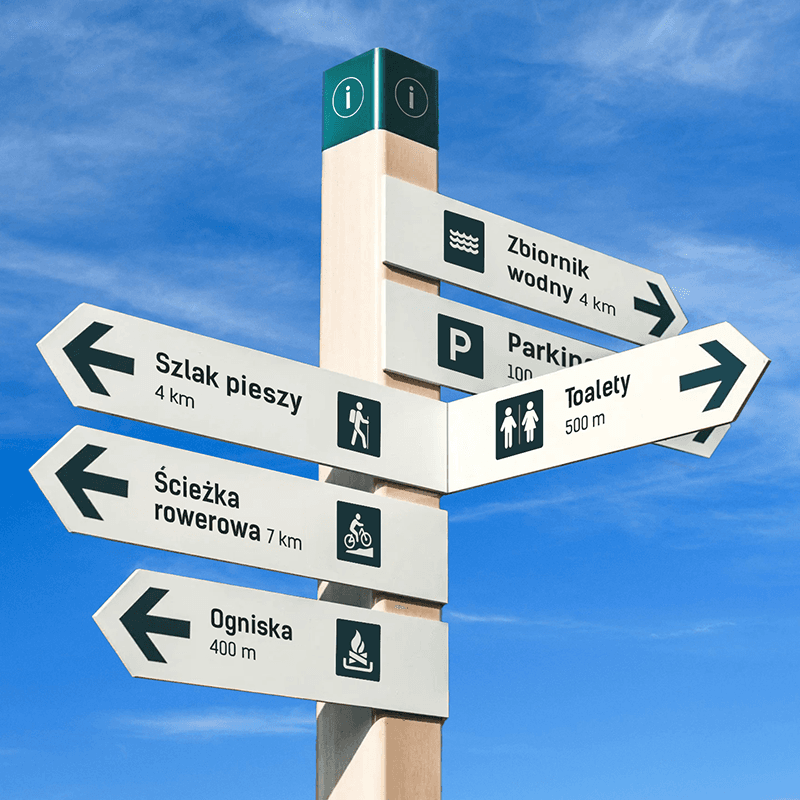
– informational directional signs,
– orientation and distance plaques,
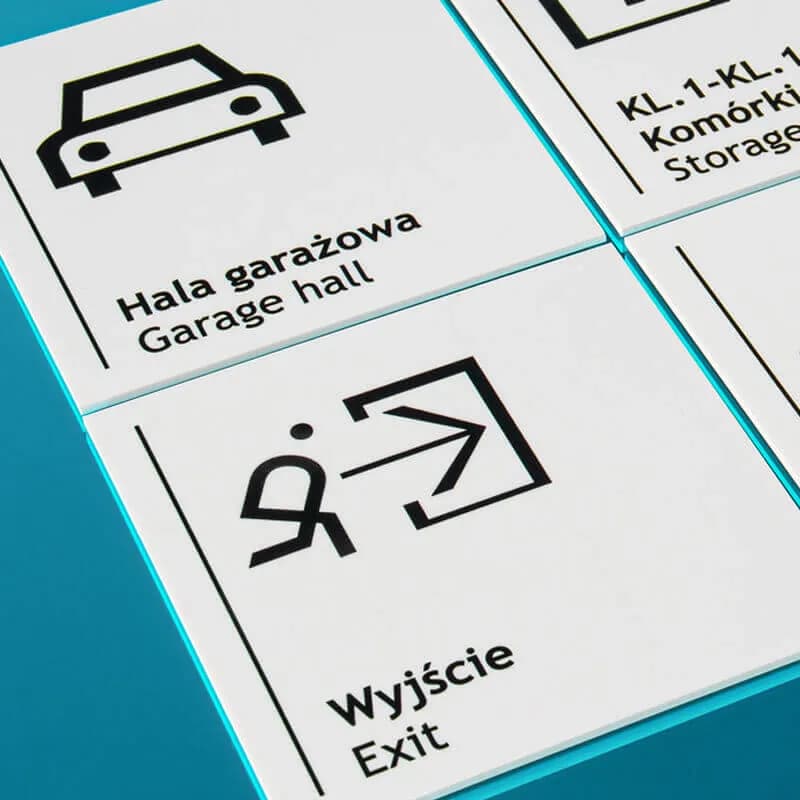
– signage for entrances, zones, and key points,
– signage for parks, open areas, and trails,
– urban and institutional signage.
Each of these elements only makes sense as part of a larger system, not as a standalone object.
HOW A WAYFINDING SYSTEM IS DESIGNED
The PRETENDE wayfinding system is developed through a fixed, repeatable process:
– analysis of the space and user behavior,
– identification of decision points and potential disorientation zones,
– design of information hierarchy and directions,
– selection of form, materials, and technologies appropriate to usage conditions,
– production of elements with predictable durability,
– preparation of the system for installation in accordance with documentation.
The goal of the process is not aesthetics alone, but readability, logic, and long-term system stability.
SINGLE RESPONSIBILITY FOR THE WAYFINDING SYSTEM
PRETENDE is responsible for the entire wayfinding system, not for individual elements.
The scope of responsibility includes:
– design of the spatial orientation system,
– production of elements in accordance with the design,
– logical and visual consistency of the entire information layout.
We do not implement random signs detached from spatial context, as this leads to information chaos and transfers risk to the investor.
LIMITS OF RESPONSIBILITY
The wayfinding system does not replace or include:
– traffic organization or changes to transport infrastructure,
– marketing or advertising content,
– investor decisions introduced after project completion without system updates.
Changes to spatial layout, facility function, or informational content introduced after project completion require a wayfinding system update and are not covered by the original scope of responsibility.
The scope of responsibility is always defined prior to project commencement.
FAQ – WAYFINDING
What is the difference between wayfinding and signage?
Signage is an element. Wayfinding is the system that gives these elements meaning and logic.
Is wayfinding only for large facilities?
No. Wayfinding systems are also applicable in smaller spaces if user decision points exist.
Can the system be expanded in the future?
Yes, provided the original logic and information hierarchy are maintained.
Who is responsible for user orientation errors?
Responsibility results from the project scope and its compliance with documentation and the actual spatial layout.
Can wayfinding be illuminated?
Yes, only when lighting serves an informational function, not a decorative one.










.webp&w=1920&q=75 "Tabliczki z alfabetem Braille'a")