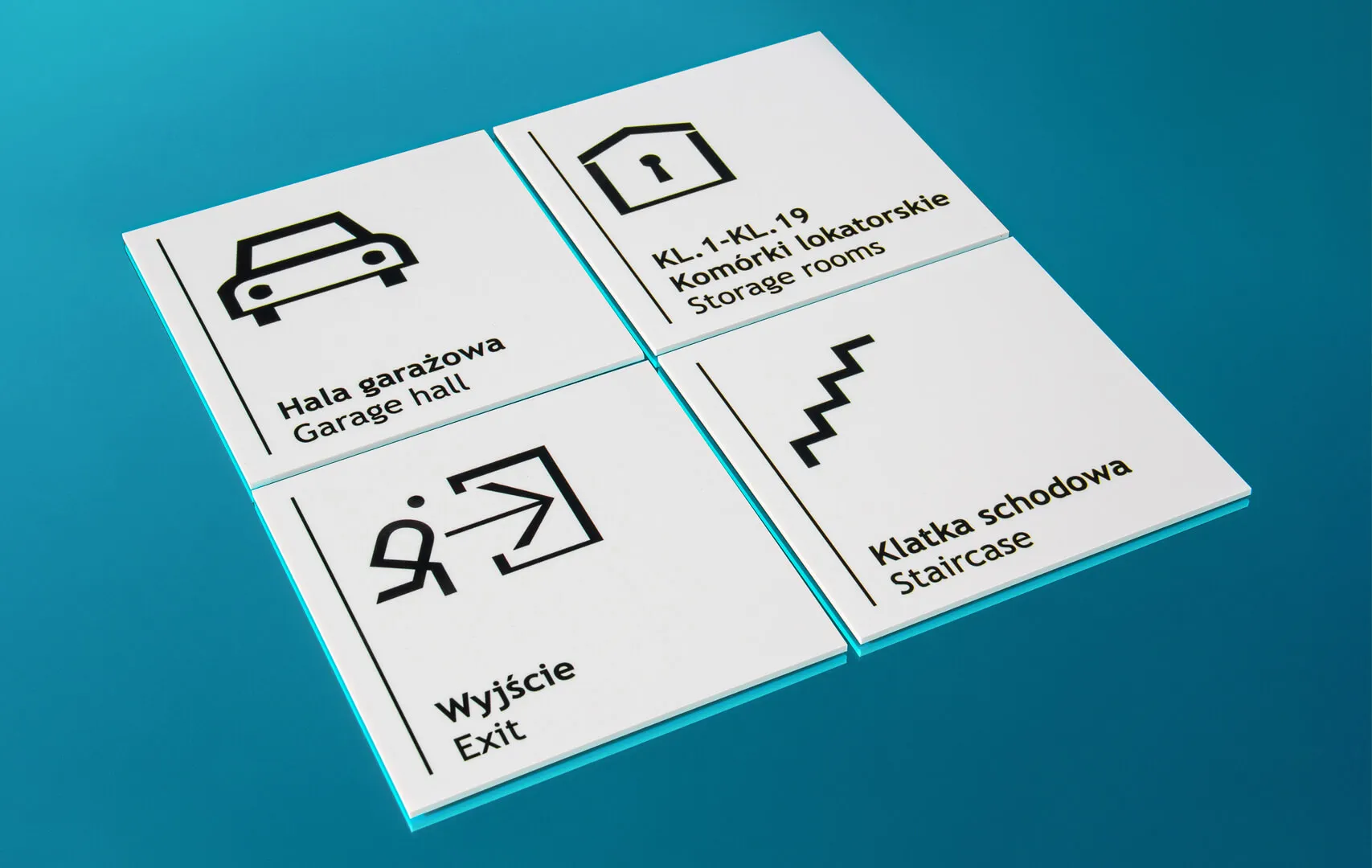

In many projects, signage is created as a collection of individual elements—boards, arrows, numbers, or logos. Each of them is designed separately, often by different people and at different stages of the investment. In the end, everything is assembled and installed in the space. From a design perspective, everything seems correct. The problem only begins when the user has to make their first decision.
A building signage system is not a set of elements. It is an information structure that should guide the user through the space without stopping them or forcing interpretation. The moment a person has to stop and think, the system stops working.
Movement through a building is based on simple decisions
The user does not analyze signage as a whole. They enter the building, look around, and search for the simplest path. They do not read every message, do not memorize information in advance, and do not build a mental map of the space. They make decisions at specific moments—where to go, whether to turn, whether they are on the right path.
If the space does not provide a clear answer exactly at that moment, the user stops. They start looking for confirmation, scanning the surroundings, going back. If the user has to stop, the signage is no longer working—it is only pretending to work.

Where chaos in signage comes from
Chaos does not result from a single mistake. It appears when signage is not treated as a system, but as a set of elements.
Most often, it comes from recurring patterns:
1. Signage designed at the end of the project
Instead of being part of the building concept, it tries to adapt to a finished space and its limitations.
2. Lack of analysis of user movement
The system does not respond to real behaviors, only to design assumptions.
3. Lack of identification of decision points
Information appears in random places, not where the user actually needs to choose a direction.
4. Lack of information hierarchy
All messages have similar weight, forcing the user to decide what is important.
5. Lack of system structure
Each element works individually, but they do not create a continuous guidance flow.
6. No connection with architecture
If signage does not result from the space, the user stops trusting it and relies on intuition.
7. Separation of design, production, and implementation
Each stage is handled separately, and overall consistency becomes no one’s responsibility.
8. No preparation for change
Over time, additional boards, corrections, and notes appear. The system grows, but does not become clearer.
In each of these cases, the result is the same—the user is left alone with a decision they should not have to make. And that means the problem has not been solved, only shifted onto the user, the building manager, or the operational team. In practice, it returns as user questions, additional signage, post-installation corrections, and time spent by teams explaining the space instead of using it. That is the real cost of signage that was “correct on paper.”

Signage as a system, not a collection of elements
Signage works only when it simplifies movement through space. It should not attract attention, but be obvious in use. A well-designed system does not require explanation. The user should not feel that they are using signage—they should feel that they simply know where to go. It is not individual boards that determine quality, but whether the whole works as one system.
Well-designed signage does not require management. Poorly designed signage becomes a constant operational problem. This is the moment when signage stops being an element of equipment and starts affecting how the entire building functions.
How to design signage that actually works
At the beginning, it is necessary to understand the space—its layout, movement directions, entry and exit points, and the moments where users make decisions. Based on this, the system logic is built: what the user needs to know, at what moment, and in what form.
Only then are the specific elements created. The system is defined much earlier—at the decision stage, not production. And this is the moment that is most often skipped in projects. That is why signage so often requires later corrections.

One responsibility instead of multiple contractors
In practice, the biggest problem is not design or production individually. The problem is their separation. When responsibility is divided, the problem does not disappear—it only changes ownership. The designer finishes at the concept stage. The contractor executes what they receive. Installation adapts to on-site conditions. And the system as a whole stops being anyone’s responsibility.
That is why signage is not something that can be effectively compared through quotes. Because what is being purchased is not boards—it is the way the space works. In projects that are meant to function, responsibility is not divided into stages. It is closed within one process—from decision, through design and technology, to production and installation. This ensures that signage does not require later “management”—it simply works. And that is exactly what determines whether the issue is closed or keeps coming back.